
The European Waste Crisis: A Blueprint for the Resilient Small and Medium-Sized Business

The End of "Away" the Emergence of the Waste Crisis
For years, the linear economy relied on a simple but flawed assumption: the concept of "away."
Under the traditional "take-make-dispose" model, businesses operated as if a product’s lifecycle ended the moment it left the consumer’s hands. Strategy was built around production and sales, while the leftovers were treated as a localized problem that would simply disappear into the infrastructure. In the 1980s, however, Europe hit a physical wall that proved "away" was a logistical impossibility. It became clear that waste wasn't vanishing; it was accumulating in a finite system that had finally reached its limit.
This waste crisis was a watershed moment for the modern economy. It marked the first time an interconnected market had to confront the fact that the linear model is physically and financially unsustainable. As landfill space disappeared and disposal fees began to climb, waste shifted from a background utility concern to a direct threat to business margins.
For today’s Small and Mid-sized Enterprises (SMEs), this history serves as a masterclass in proactive strategy. The crisis forced a radical transition toward frameworks like Extended Producer Responsibility (EPR)—moving the cost of a product’s end-of-life from the public's shoulders back onto the company’s balance sheet. By understanding this shift, business owners can learn to future-proof their operations today, turning potential liabilities into resilient, circular assets before the market mandates the change.
The 1980s: A Continent at Capacity
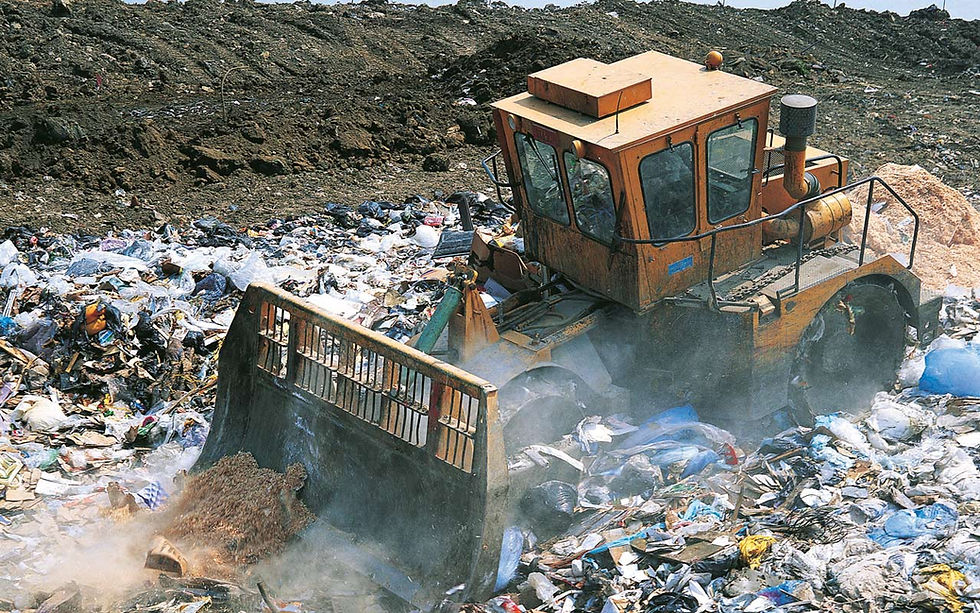
By the mid-1980s, the post-war consumer boom—fueled by decades of rapid industrial expansion and the "throwaway" culture of the 1960s—had finally outpaced the infrastructure designed to support it. The linear model, which assumed that natural systems could indefinitely absorb the byproducts of growth, was "leaking" value at an unsustainable rate. As urban centers expanded and available land dwindled, the physical limits of the landscape became a financial liability that the private sector could no longer ignore. This wasn't just a failure of waste management; it was the first sign that the industrial "efficiency" of the 20th century had reached its natural breaking point (European Environment Agency, 2015).
The Breaking Point
As landfills across the continent reached capacity almost simultaneously, the crisis moved from a back-end utility issue to a front-page emergency. This scarcity sparked "garbage wars" between regions as borders closed to waste transport. European environmental history from this era shows that these logistical failures weren't just a nuisance; they represented a fundamental breakdown in how the continent handled material flow (European Environment Agency, 2015). For the first time, businesses faced a terrifying reality: the "away" they had relied on for decades had effectively been shuttered.
The Escalating Costs
As disposal space became a scarce commodity, the financial cost of getting rid of waste skyrocketed. For the average manufacturer, this functioned as an unannounced "waste tax." It was no longer a negligible fee; it was a volatile expense that directly threatened margins. Early analysis into these market shifts highlighted that businesses that hadn't accounted for the "end-of-life" costs of their products found themselves financially exposed to a problem they had previously ignored (Lindhqvist, 1990).
The NIMBY Factor
Compounding the crisis was the rise of the NIMBY (Not In My Backyard) sentiment. Public outcry against new landfills and incinerators meant that businesses could no longer "expand" their way out of the problem. This social and political pressure forced a radical shift in perspective: if you could not move the waste out, you had to stop creating it in the first place. This transition marked the beginning of a decoupling process—where economic growth finally had to be separated from the volume of material consumed (Eurostat, 2026).

The Consequences of the Crisis
The systemic failures of the 1980s led to a profound realization among policymakers: you cannot manage a crisis of this scale simply by moving "trash" from one location to another. To solve the problem, the focus had to shift from managing waste to managing the resource itself.
The Legislative Pivot
Governments across Europe began implementing strict directives focused on landfill diversion and aggressive material recovery. These weren't just environmental suggestions; they were hard mandates that disrupted traditional supply chains. This era marked a fundamental shift in the European outlook, as the state moved toward a synthesis of economic and environmental oversight to ensure long-term resource security (European Environment Agency, 2015). The goal was no longer to hide the byproduct of consumerism, but to keep those materials circulating within the economy.
Financial Liability: The Birth of EPR
The most significant outcome of this era was the formalization of Extended Producer Responsibility (EPR). Proposed as a strategy to decrease the environmental impact of products by making the manufacturer responsible for the entire life cycle, EPR fundamentally changed the rules of commerce (Lindhqvist, 1990).
For the first time, a business remained financially responsible for its product even after the point of sale. This moved waste management from a "public problem" funded by taxpayers to a "private balance sheet" item. As global guidance eventually standardized, EPR became a "how-to" for the modern industrial world, forcing companies to account for end-of-life costs during the initial design phase (OECD, 2016).
The Resilience Lesson for SMEs
This shift turned waste into a measurable financial risk. For a small manufacturer, failing to account for these costs meant being hit with unexpected liabilities. However, those who adopted these frameworks early found they could decouple their growth from material consumption, creating a leaner, more resilient business model that thrived even as resource productivity became a key economic metric (Eurostat, 2026).

How Europe Led the Circular Adoption
The pivot toward a circular model in Europe was not merely an environmental choice; it was a pragmatic response to geopolitical and economic realities. For a continent with limited domestic raw materials, resource management became a core component of industrial survival.
Resource Security as Strategy
Unlike the United States or Russia, Europe lacked vast, untapped natural resources. This scarcity meant that every discarded product represented a lost asset. Transitioning toward a circular model was, at its heart, a national security strategy designed to reduce dependence on increasingly volatile global commodity markets. By treating waste as a domestic "mine," the European Commission sought to secure the raw materials necessary for growth and job stability (European Commission, 2008).
The Innovation Surge
The pressures of the 1980s crisis acted as a catalyst for a new tier of agile SMEs. These businesses realized that traditional waste management was a "sunk cost," whereas resource efficiency was a "saved margin." They moved beyond simple recycling and began redesigning their business models around resource productivity—decoupling their economic output from the sheer volume of material they consumed (Eurostat, 2026).
The result was a generation of businesses that were:
Lower Risk: Less exposed to the price swings of imported raw materials.
Lower Waste: Minimizing the "waste tax" that burdened their competitors.
Higher Margin: Extracting more value out of every kilogram of material used.
Strategic Insight for the SME
This historical shift proves that when resource security becomes a priority, the most resilient businesses are those that treat materials as an investment to be managed, rather than a cost to be discarded. For the modern SME, following this blueprint means building a business that is insulated from the next global supply chain disruption.

Lessons for the Modern SME
The history of the European waste crisis is not just a study of the past; it is a roadmap for the future. For the modern SME, there are three definitive lessons to be drawn from those who successfully navigated the transition to a circular model.
Lesson 1: Efficiency as a Strategic Hedge
The European businesses that adapted early to resource scarcity were significantly less vulnerable to the global commodity price spikes that defined the following decades. By optimizing material flow, these companies lowered their "resource intensity"—the amount of raw material required to generate a dollar of revenue. In a market where material costs are increasingly volatile, efficiency isn't just about saving pennies; it is a competitive edge that protects your bottom line from external shocks.
Lesson 2: The Advantage of Regulatory Readiness
The 1980s proved that businesses waiting for the law to change are always playing catch-up. Proactive SMEs didn't just follow new environmental directives; they helped define the standards that their competitors later struggled to meet. By staying ahead of the regulatory curve, these leaders avoided the "compliance panic" and the associated costs of emergency restructuring. For the modern business, anticipating shifts in sustainability law is a way to ensure that you are the one setting the pace in your industry.
Lesson 3: Decoupling Growth from Material Footprint
The ultimate lesson of the circular transition is that a business can grow its revenue while shrinking its material footprint. This is achieved by shifting the perspective: resources must be viewed as assets to be managed rather than expenses to be discarded. When you decouple economic growth from material consumption, you break the cycle of "more production equals more waste." This leads to a leaner, higher-margin business model that prioritizes value creation over volume (Eurostat, 2026).
Conclusion: Future-Proofing Through History
The events of the 1980s provided the world with a definitive proof of concept: the linear model eventually hits a physical and financial wall. History shows that when a market reaches its carrying capacity, the businesses that survive are not those that try to build higher walls, but those that choose a different direction entirely.
Circularity is more than an environmental philosophy; it is the discipline of resource resilience. It ensures that your business is already decoupled from the volatile "take-make-dispose" cycle when the next logistical or financial wall appears. By shifting your perspective today, you are not just complying with the future—you are creating it.

Are you running a 1980s linear model in a 2026 market?
Start your journey towards a sustainable business with these tools. 👇
Additional Resources
Books
Coursera Courses
Websites
References
European Commission. (2008). The raw materials initiative: Meeting our critical needs for growth and jobs in Europe (COM/2008/0699 final). https://eur-lex.europa.eu/legal-content/EN/TXT/?uri=CELEX:52008DC0699
European Environment Agency. (2015). The European environment — state and outlook 2015: Synthesis report. Publications Office of the European Union. https://portals.iucn.org/library/node/45120
Eurostat. (2026). Resource productivity statistics - decoupling economic growth from material consumption. European Commission. https://ec.europa.eu/eurostat/statistics-explained/index.php?title=Resource_productivity_statistics
Lindhqvist, T. (1990). Towards an extended producer responsibility: Analysis of the experiences and proposals (Report No. 90:11). Lund University, International Institute for Industrial Environmental Economics. https://lup.lub.lu.se/search/files/4433708/1002025.pdf
OECD. (2016). Extended producer responsibility: Updated guidance for efficient waste management. OECD Publishing. https://www.oecd-ilibrary.org/environment/extended-producer-responsibility_9789264256385-


Comments